
We are using cookies.

We are using cookies on this web page. Some of them are required to run this page, some are useful to provide you the best web experience.

I accept

Individual Cookie Settings

Only accept required cookies.

Privacy Notes Imprint

Privacy settings

Here is an overview of all cookies use

Cookies for Statistics

Statistic cookies anonymize your data and use it. These information will help us to learn, how the users are using our website.

Show Cookie Informationen

Google Conversion-Tracking-Tag

Save

BackOnly accept required cookies.

Privacy Notes Imprint

  • Jump to main menu
  • Jump to side menu
  • Jump to content
  • Jump to footer
  • Contrast
  • de
  • en
Logo htw saar – To homepageLogo htw saar – To homepage
Search
  • Betrieb und Mobilität
  • Mobility Strategy
  • Contact
  • Locations
  • Library
  • Canteen menu
  • Moodle
 
  • htwsaar
  • Nachhaltigkeit
  • Betrieb und Mobilität

htw saar is a public-law corporation. As a state-run institution, it cannot act independently under building regulations, since the buildings it uses are owned by the state and overarching framework agreements—such as those governing energy or procurement—determine its scope of action.

Within this framework, however, the university consciously fosters a social environment. As a campus-based institution, it requires space and mobility. People come together on campus to learn, work, and spend time, thereby bringing vitality to the surrounding areas. This dynamic also extends into the neighborhood. htw saar actively reaches out to the community, for example through the “University in the City” initiative, under which the university participated in the state capital’s “Sommerstraßen 2025” project and opened the campus avenue for cultural events. The htw saar’s dining halls are also meeting places for students, staff, and external guests of different generations. Such forms of community cannot be replaced in the digital space.

Read moreUniversity operations are inextricably linked to resource consumption. Electricity, drinking water, heat, fuels, IT infrastructure, and built-up areas are necessary to enable teaching, research, and administration. The construction and maintenance of libraries, laboratories, lecture halls, and office buildings generate significant CO2 emissions. At the same time, universities train skilled professionals and develop solutions that are urgently needed for sustainable and societal transformation. It is therefore crucial to consciously shape university operations through energy conservation, renewable energy generation, sustainable mobility, digital solutions, responsible procurement, and a thoughtful approach to materials and media. In this way, the unavoidable ecological footprint becomes the starting point for responsible action.

Energy consumption at htw saar is systematically recorded and transferred to the BayCalc monitoring tool. This creates transparency and a robust foundation for identifying potential savings, reviewing progress, and continuously refining measures. The Campus Management and University Services Department is responsible for the sustainable management of heating, electricity, and water supply as well as building management. It develops energy-saving measures and optimizes the use of renewable energy. The University Construction and Campus Development Office ensures that new construction and renovations are carried out in accordance with ecological standards. Together with the Sustainability Division, Campus Management works to continuously reduce the university’s carbon footprint and increase the energy efficiency of all campuses.

htw saar is also directly affected by the consequences of climate change. Rising temperatures and extreme weather require adjustments to building operations to ensure a healthy learning and working environment. In addition to heating and cooling, this includes providing portable fans, free drinking water, and flexible work-from-home policies during periods of extreme heat and black ice. These measures demonstrate that sustainable action requires a balance between health protection and resource conservation. Climate adaptation therefore necessitates forward-looking concepts that combine ecological, social, and economic sustainability. The following section examines the future of campus development at the Alt-Saarbrücken site and presents initial consumption figures as well as details on the mobility concept.

Current Projects

As part of the preparation of the sustainability report, we began systematically tracking greenhouse gas emissions. The goal is to establish a transparent and traceable data foundation that both reflects current emission levels and provides starting points for future reduction measures. Greenhouse gas accounting is a central component of the strategic development of the university’s sustainability activities.

We surveyed the higher education landscape to analyze existing approaches and tools for greenhouse gas accounting. In addition, various data collection tools were evaluated. Key factors included the tools’ fundamental compatibility with the university’s structural conditions and the ability to conduct recurring, location-specific collection and analysis of emissions—given multiple geographically dispersed locations and a heterogeneous energy supply—in order to present university-specific emission sources in a differentiated manner. Another key criterion was the mapping of relevant emission categories according to direct emissions from operations (Scope 1), indirect emissions resulting from, for example, the purchase of energy sources (Scope 2), and emissions along the value chains (Scope 3). Additionally, the system needed to support intuitive data entry and the ability to consolidate information from various internal data sources. Based on these criteria, the decision was made to use the BayCalc1 tool.

The survey for the aforementioned categories was conducted for the period 2024 and covers all locations. In this first report, procurement and waste are not included in the calculation. In addition to emissions from the HIZ data center—which is centrally operated by all universities in Saarland—the report does not include purchased goods and capital goods (machinery and equipment; consumables) as well as waste disposal.

A key focus of the first report is the analysis of mobility-related CO2 emissions (see Mobility Concept).

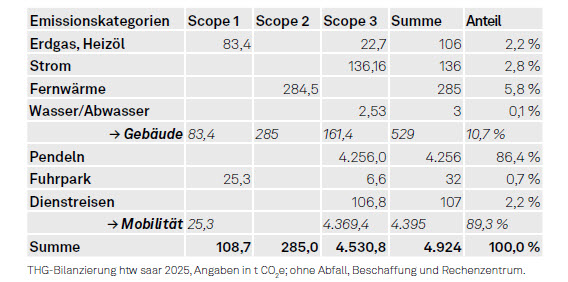
Although the figures presented here are subject to certain inaccuracies and comparisons between universities are difficult due to differing data collection bases and calculation methods, it is clear that by far the largest source of emissions is the commuting of university members. Overall, the annual specific greenhouse gas emissions of htw saar (0.75 t CO2e/person; 0.12 t CO2e/m² per year of built-up floor space) place it in the lower middle range in an international comparison of universities.2 Thanks to the use of green electricity, the contribution of the relatively high electricity demand to total CO2 emissions is very low. If electricity were sourced from the German grid mix, emissions would be more than ten times higher, at 1,510 t CO2e. Strategically, greenhouse gas accounting is designed so that data collection can be further developed, refined, and standardized in the future, thereby enabling external verification or certification.


1 BayCalc Guideline (Version 2.1) for the Accounting of Greenhouse Gas Emissions from Universities in Bavaria; 11/2025; www.bayzen.de/materialien/baycalc
2 Helmers, E., Chang, C.C., & Dauwels, J. Carbon footprinting of universities worldwide: Part I—objective comparison by standardized metrics. Environ Sci Eur 33, 30 (2021). https://doi.org/10.1186/s12302-021-00454-6

htw saar sees itself as a campus-based university. Social interaction enhances the learning process; teams collaborate more efficiently in person; and on-site services and laboratories require staff to be present on campus. Travel to and from project partners, field trips, and conference attendance foster knowledge acquisition and exchange. Modern mobility enables the convergence of many stakeholders from diverse backgrounds. At the same time, commuting and travel involve such a high level of resource consumption that mobility-related greenhouse gas emissions account for the largest share of htw saar’s carbon footprint. Against this backdrop, the university has developed a comprehensive mobility strategy in collaboration with an external service provider. The goal is to estimate mobility-related CO₂ emissions and reduce htw saar’s CO₂ emissions through a modern, climate-friendly, and socially equitable mobility mix. Data on international mobility (cross-border commuters, Erasmus+, DFHI) were not included in this first report. 

The extensive analyses have clearly shown that the largest CO₂ emissions are caused by the commuting of university members. Business travel and the vehicle fleet contribute only a single-digit percentage. Commuting from longer distances and within the local area, in particular, offers potential for CO₂ savings through the promotion of carpooling and bicycle mobility.

A survey conducted as part of the mobility strategy, along with vehicle counts, indicates significant potential for carpooling. During an implementation workshop, the introduction of a digital carpooling platform was therefore decided upon as a priority measure. It is intended to facilitate networking, reduce emissions, and save costs at the same time.

To promote bicycle use within a radius of up to ten kilometers, more weather-protected parking facilities and service stations are to be installed, and better connections to municipal bike paths are to be pursued. By the end of 2025, the first bike-friendly street in Saarland was completed, connecting the Alt-Saarbrücken campus with the city center. Participation in “Stadtradeln,” the JobRad leasing program, and the AStA bike repair shop already complement the existing offerings. These measures were presented, among other things, at the Bike Action Day and workshop in July 2025 and discussed across all status groups.

Although the vehicle fleet accounts for only a small portion of total emissions, its transition to a corporate car-sharing model consisting exclusively of electric vehicles serves as a model for others. The transition is to be combined with the development of a service-oriented digital booking and management platform, through which university members’ private trips using pool vehicles can also be billed in the future.

All measures are supported by information and engagement: interactive mobility maps, as well as campaigns and contests, make sustainable mobility visible and tangible. The htw saar thus views mobility not as a sacrifice, but as an opportunity for greater flexibility, health, and climate protection—and as a contribution to its role as a model in the region.

Details on the mobility strategy can be found at www.htwsaar.de/nachhaltigkeit/betrieb-und-mobilitaet/mobilitaetsstrategie

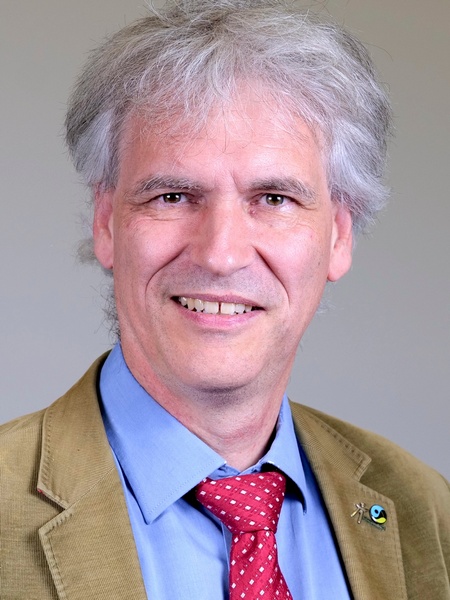
“For us, sustainable mobility is more than just a concept—it combines climate protection, health, and flexibility. With our mobility strategy, we aim to demonstrate ways to make commuting and business travel resource-efficient and attractive.”

Dr. Markus Ehses
Sustainability Officer

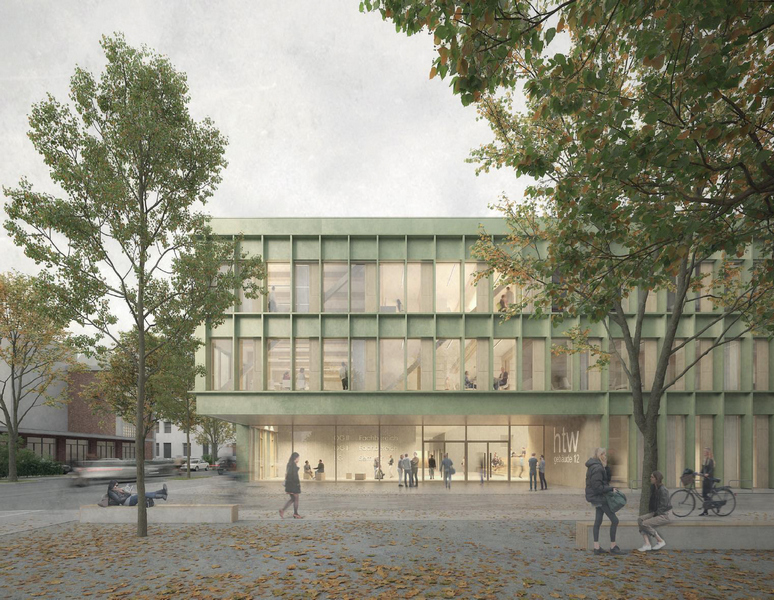
Das Bild zeigt den preisgekrönten Entwurf für den Neubau des Gebäudes 12 der htw saar. Ein modernes, gläsernes Gebäude mit grünlichem Rahmen.   Die Fassade besteht aus großen Glasflächen, die von einem feinen Raster aus vertikalen und horizontalen Streben eingefasst sind. Innen sind mehrere Geschosse mit Galerien, Treppen und Menschen erkennbar, was dem Gebäude eine offene, transparente Wirkung gibt.   Vor dem Gebäude liegt ein weiter Platz mit hellem Pflaster.

The existing buildings on the Alt-Saarbrücken campus can no longer be renovated. In addition, a space requirements analysis revealed a greater need for laboratory and classroom space. The state of Saarland has therefore approved extensive replacement and expansion construction projects. The award-winning design for the planned Building 12 sends a clear signal in favor of sustainable architecture and responsible campus development. The concept combines modern teaching and research spaces with ecologically sound construction. With this new building, the client is realizing the first public building in Saarland to meet the BNB Silver Standard. This pilot project aims to demonstrate how a functional university building can meet the challenges of modern pedagogy on the one hand, and the growing demands for climate protection, resource conservation, and energy efficiency on the other. The winning design stands out for its clear structure and flexible usage options. An optimized building envelope reduces energy consumption, while integrated photovoltaic systems enable decentralized and climate-friendly energy generation. Sustainable materials, natural lighting, a green roof, and good connectivity to campus facilities also contribute significantly to the design’s success. The newly established bike path runs directly alongside
the campus building.

Porträtfoto einer Frau vor hellem Hintergrund.   Die Frau hat mittellange, dunkle Haare.   Sie hat einen hellen Teint und trägt kleine, runde Ohrringe.   Ihr Gesicht ist frontal aufgenommen, sie lächelt leicht mit geschlossenen Lippen.   Die Augen sind offen und blicken geradeaus.

“This project not only creates additional space for teaching and
research but also serves as a showcase that positions htw saar as a
forward-thinking university in the field of
sustainable construction.”

Dipl.-Ing. Tanja Sattler, M.Eng.
, Office of University Construction and Campus Development

Logo der Initiative Fair Trade Universities

Fair trade means more than just buying coffee with a Fairtrade label on the package. Fair trade is an attitude that reflects a commitment to acting in a socially just, environmentally responsible, and economically considerate manner. 

Fairtrade has made it its mission to promote fairer conditions in global trade and to create a more balanced economic system worldwide. It creates greater fairness in trade by ensuring stable minimum prices, promotes equality as well as environmental and climate protection, prohibits exploitative child labor, rewards community projects, and conducts regular audits and independent inspections.

Two universities, one goal:Saarland University (UdS) and the Saarland University of Applied Sciences (htw saar) are jointly committed to a fairer global economy through the “Fairtrade Universities Saar” action alliance. The Fairtrade initiative has been active since the 2014/15 winter semester; in 2017, htw saar was certified as the 14th Fairtrade University for the first time, and was most recently recertified in May 2026.

Universities as Drivers of Social Change
Through their core missions in teaching, research, and knowledge transfer, universities make a significant contribution to social change. They train specialists and leaders, develop solutions to current challenges, and provide scientifically grounded contributions to public debate. The Fairtrade Universities Saar leverage this potential specifically to promote fair trade and supply chains.

The focus is on the following topics:

  • Global production conditions
  • Structures of international supply chains
  • Sustainable procurement and food supply

The universities raise awareness among their members through a variety of initiatives:

  • Information campaigns such as the Fair Breakfast or information booths
  • (Re-)certification as Fairtrade Universities
  • Offering fair-trade products in dining halls and cafeterias

These activities are coordinated across universities by a steering group that meets several times per semester. It includes representatives from the University of Saarland (UdS), htw saar, the student councils (Sustainability Department), the Student Services Association, ESG, KHG, the City of Saarbrücken (Office for Climate and Environmental Protection), the Fair Trade Initiative Saarbrücken, the Fair Trade Initiative Saarland, as well as committed students and staff.

In addition, Fairtrade Universities Saar is part of a close-knit network of initiatives—locally in Saarbrücken, throughout Saarland, nationwide, and with partner organizations in the Global South.

Get involved in the FairTrade Initiative

- at the FairTrade information booths and in the FairTrade workshops, the Fairtrade steering group

- in planning and carrying out campaigns (fair roses, fair Santa Clauses, fair chocolate, fair cocoa)

- with your own Fair Trade or sustainability project, e.g., as part of service learning

- with your own campaign at htw saar, which we’d be happy to support

The FairTrade Initiative at htw saar actively participates in local networks and supports activities related to Fair Trade, Fair Travel, Fair Business, and sustainability.
In September 2017, htw saar was awarded the “Fairtrade University” seal. Since then, htw saar has been recertified as a Fairtrade University twice (2023 and 2025). Since the 2017/18 winter semester, the Fairtrade Initiative, in collaboration with the StudienStiftungSaar, has been awarding a sustainability/Fairtrade scholarship to students who are particularly committed to fair trade. 

If you want to convince your fellow students of the Fairtrade philosophy and also contribute to fair trade, you can become a Fairtrade Ambassador. You will be prepared for this through training workshops. Contact the steering committee or email nachhaltigkeitnoSpam@noSpamhtwsaarnoSpam.de for details. 

We can confirm your commitment with a certificate and an entry in the “sozial(und)kompetent” bonus booklet.

The Fairtrade steering group at htw saar 2025-27 consists of Dr. Markus Ehses (Sustainability Officer, Administration), Mathias Lautwein (AStA), Nadine Engel (Student Services, Cafeteria), and Anja Laue (Evangelical Student Community, ESG).

Auszeichnungen und Partner der htw saar

footer area

  • Impressum
  • Datenschutz
  • Erklärung zur Barrierefreiheit
  • Cookiesettings

Socialmedia

  • Facebok
  • Instagram
  • LinkedIn
  • youtube
  • flickr
  • blog

Contact us

Saarland University of Applied Sciences

Goebenstraße 40
66117 Saarbrücken

Telephone: (0681) 58 67 - 0
Fax: (0681) 58 67 - 122
E-mail: infonoSpam@noSpamhtwsaarnoSpam.de

Locations

  • Campus Alt-Saarbrücken
  • Rotenbühl Campus
  • Campus Göttelborn
  • HTZ at the Saar Innovation Campus

htw saar

  • Press releases
  • Announcements
  • Semester dates/lecture times
  • Working at the htw saar
  • First aid / fire protection
  • Occupational health and safety (AGUM)
  • IT emergencies
  • Radiation and laser protection
  • Webmailer
  • Intranet (for employees)
  • Login (for employees)

Supervisory authority:
Saarland Ministry of Finance and Science