
htw saar sees itself as a campus-based university. Social interaction enhances the learning process; teams collaborate more efficiently in person; location-specific services and laboratories require staff to be present on campus; and field trips and conference participation foster knowledge acquisition and exchange. Modern mobility enables the convergence of many stakeholders from diverse backgrounds. At the same time, commuting and travel consume resources to such an extent that mobility-related greenhouse gas emissions account for the largest share of htw saar’s carbon footprint. Against this backdrop, the university has developed a comprehensive mobility strategy in collaboration with an external service provider. The goal is to estimate mobility-related CO₂ emissions and reduce htw saar’s CO₂ emissions through a modern, climate-friendly, and socially equitable mobility mix. Data on international mobility (cross-border commuters, Erasmus+, DFHI) were not included in this first report.
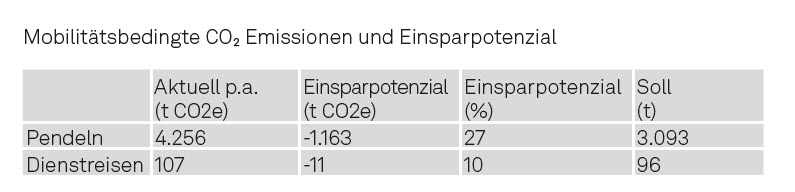
The extensive analyses have clearly shown that the largest CO₂ emissions are caused by university members’ commuting; business travel and the vehicle fleet contribute only a single-digit percentage. Commuting from longer distances and within the local area in particular offers potential for CO₂ savings through the promotion of carpooling and bicycle mobility on campus.
A survey conducted as part of the mobility strategy, along with vehicle counts, indicates significant potential for carpooling. During an implementation workshop, the introduction of a digital carpooling platform was therefore decided upon as a priority measure. It is intended to facilitate networking, reduce emissions, and save costs at the same time.
To promote bicycle use within a 10-kilometer radius, more weather-protected parking facilities and service stations are to be installed, and better connections to municipal bike paths are to be established. By the end of 2025, the first bike-priority street in Saarland was completed, connecting the Alt-Saarbrücken campus with the city center. Participation in “Stadtradeln,” the JobRad leasing program, and the AStA bike repair shop already complement the existing offerings. These measures were presented, among other things, at the Bike Action Day and workshop in July 2025 and discussed across all status groups.
Although the vehicle fleet accounts for only a small portion of total emissions—in the low single digits—its transition to a corporate car-sharing model consisting exclusively of electric vehicles serves as a model for others. This will reduce emissions by about two-thirds. The transition is to be combined with the development of a service-oriented digital booking and management platform, through which university members’ private trips using pool vehicles can also be billed in the future.
All measures are supported by information and engagement: interactive mobility maps on the intranet, as well as campaigns and contests, make sustainable mobility visible and tangible. htw saar thus views mobility not as a sacrifice, but as an opportunity for greater flexibility, health, and climate protection—and as a contribution to its role as a model in the region.
“For us, sustainable mobility is more than just a concept—
it combines climate protection, health, and flexibility.
With our mobility strategy,
we aim to demonstrate ways to make commuting and business travel resource-efficient and
attractive.”
Dr. Markus Ehses
Sustainability Officer