
We are using cookies.

We are using cookies on this web page. Some of them are required to run this page, some are useful to provide you the best web experience.

I accept

Individual Cookie Settings

Only accept required cookies.

Privacy Notes Imprint

Privacy settings

Here is an overview of all cookies use

Cookies for Statistics

Statistic cookies anonymize your data and use it. These information will help us to learn, how the users are using our website.

Show Cookie Informationen

Google Conversion-Tracking-Tag

Save

BackOnly accept required cookies.

Privacy Notes Imprint

  • Jump to main menu
  • Jump to side menu
  • Jump to content
  • Jump to footer
  • Contrast
  • de
  • en
Logo htw saar – To homepageLogo htw saar – To homepage
Search
  • Studium
  • Bachelor Architektur (B.A.)
  • Master Architektur (M.A.)
  • Contact
  • Locations
  • Library
  • Canteen menu
  • Moodle
 
  • htwsaar
  • htw saar
  • Schools and institutes
  • School of Architecture and Civil Engineering
  • Schule für Architektur Saar
  • Studium
  • Bachelor Architektur (B.A.)

Study Management

Course Structure

Program-Specific Study and Examination Regulations (Appendix to the ASPO)

Architecture Bachelor's Program Course Catalog

https://moduldb.htwsaar.de

Internship Regulations of htw saar

Education Profile

The Bachelor’s program in Architecture is divided into a two-semester foundational phase and a four-semester core phase, culminating in a Bachelor of Arts degree. Students must provide proof of an internship by the third semester. Between the introductory phase and the core curriculum, a counseling session is held to help students orient themselves in their studies. The Bachelor’s program provides the foundation for professional practice in a wide range of fields within architecture. The Bachelor of Arts degree is a prerequisite for admission to a Master’s program.

Course Objective

The bachelor’s program teaches technical and scientific fundamentals in a condensed, modular format. At the same time, in line with the department’s focus on interdisciplinary collaboration with design, art, and technology, opportunities for creative development are fostered and methodologically supported through design and drafting seminars and exercises. The fundamental educational objectives of the previous architecture diploma program have been reorganized into a “Bachelor of Arts in Architecture” program. This degree qualifies graduates for professional practice but does not grant chamber membership. Students who, despite possessing specialized technical skills, struggle with the comprehensive requirements of a Diplom or Master’s program are now offered a concentrated 6-semester Bachelor’s degree instead of a long-term program. Thanks to the holistic orientation of the curriculum, there is nevertheless the opportunity for later specialization and further qualification, for example through a Master’s program at other universities.

Course of Study

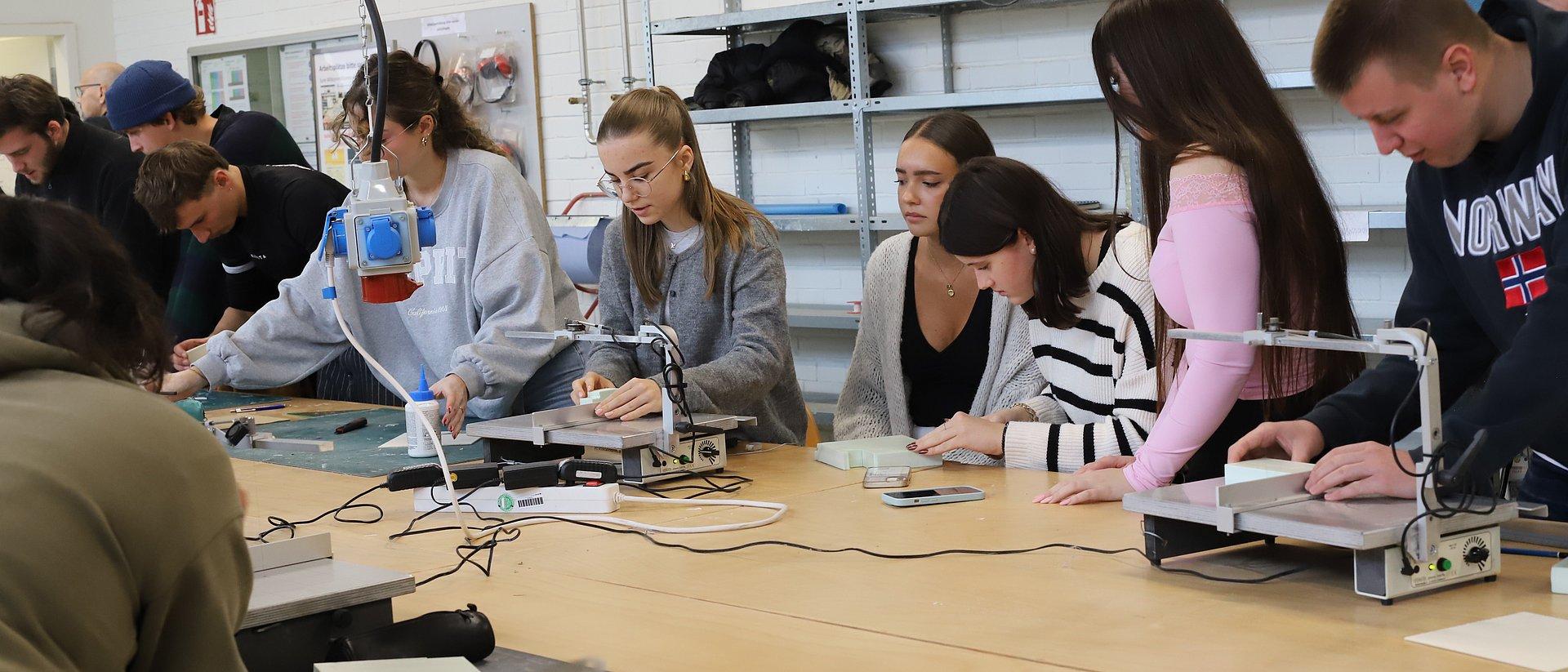
The bachelor’s program begins with a two-semester foundational course. This course has a design focus and also teaches the technical fundamentals of the program. It includes exercises, seminars, and accompanying lectures. The foundational course is designed to develop students’ manual skills, sharpen their senses, and awaken their creative abilities. The skills acquired here can be applied in other creatively oriented degree programs and professions. The academic and subject-specific courses in these first two semesters lay the groundwork for the technical and theoretical knowledge required for the Bachelor of Arts in Architecture degree. Academic advising after the foundational phase The goal of the foundational phase is to review students’ course selection and prepare them for the core curriculum. Therefore, the foundational phase concludes with academic advising after the completion of the second semester, serving to help students assess their academic performance early on to prevent dropping out later. Results and recommendations are communicated to students in individual meetings.

1st Semester: FUNDAMENTALS
The first semester teaches the fundamentals of architectural skills. The central course is “Fundamentals of Spatial Design,” which focuses on spatial, conceptual, and design-related contexts. Further foundational instruction takes place in the courses Building Construction, Building Materials Technology, Art and Architectural History, Architectural Theory, Descriptive Geometry, and Visualization Methods. A project week focusing on a common thematic area is held across all year levels.

2nd Semester: ADVANCED FOUNDATIONS
The second semester deepens the acquired foundational architectural skills. The central course here is the “Fundamentals of Design” project, which focuses on design and structural relationships. This central design project is accompanied by supporting and advanced foundational courses such as Building Construction, Building Physics, Art and Architectural History, Sociology, Structural Engineering, and CAD. Freehand drawing rounds out the foundational training for aspiring architects. An excursion takes place alongside the project.

The foundational course is followed by a four-semester core curriculum focused on technical and design aspects. Students lay the groundwork for professional qualifications required for everyday work as architects through practical assignments, particularly in the areas of design and building construction. In the project modules, the complexity of the assignments increases progressively as they build upon one another. The educational goal is to develop students into well-rounded individuals through this gradual increase in the demands placed on design and construction and their complexity.

3rd Semester: Urban Project
The third semester builds upon the acquired fundamentals. The central course is a project. The focus here is on developing solutions for housing, residential buildings,
the residential environment, and the integrated design of interior and exterior spaces. This design module is supported by specialized courses such as urban planning, building science, structural engineering, structural design, and building services engineering. A project week focusing on a common set of themes takes place across all year levels.

4th Semester: Sociocultural Project
The central course is a sociocultural project. In engaging with civil society, the goal is to
discover the potential of the built environment, evaluate it correctly, reorganize it, and shape it through dialogue. This design module is supported by specialized courses such as interior design and building theory, structural engineering, historic preservation, techniques for renovating older buildings, and building surveying. An excursion takes place alongside the project.

5th Semester: Urban Planning Project and Climate-Optimized Project
The focus of the fifth semester is an urban planning project and a climate-optimized project. The urban planning project centers on the design process for an urban-scale open-space design with a mixed-use program. In the climate-optimized project, the steps of building design are taught and practiced in an integrated manner. The focus is on the entire design process, beginning with urban planning analyses and the development of design variants, through detailed planning, to the complex visualization and personal presentation of the building design. In parallel, modules on sociology, building construction, and building technology are taught or further explored. A catalog of required electives allows students to develop their own areas of focus. A project week centered on a common thematic area takes place across all year levels.

In the sixth semester, courses cover topics such as architectural theory, legal foundations, and construction management.
The sixth semester concludes with the bachelor’s thesis. The bachelor’s thesis consists of a project on a suitable architectural topic and is written during the sixth semester. Students are able to independently address a problem within their field using scientific methods within this specified timeframe. The faculty formulates annually changing topic proposals for the bachelor’s thesis in accordance with consistent requirements.

Admission Requirements

  1. The requirements for university admission are governed by the General Study and Examination Regulations (ASPO) of htw saar, as well as the Saarland Admission Regulations.

  2. In addition, proof of practical work experience is required. The duration and details are governed by the General Internship Regulations of htw saar.

Auszeichnungen und Partner der htw saar

footer area

  • Impressum
  • Datenschutz
  • Erklärung zur Barrierefreiheit
  • Cookiesettings

Socialmedia

  • Facebok
  • Instagram
  • LinkedIn
  • youtube
  • flickr
  • blog

Contact us

Saarland University of Applied Sciences

Goebenstraße 40
66117 Saarbrücken

Telephone: (0681) 58 67 - 0
Fax: (0681) 58 67 - 122
E-mail: infonoSpam@noSpamhtwsaarnoSpam.de

Locations

  • Campus Alt-Saarbrücken
  • Rotenbühl Campus
  • Campus Göttelborn
  • HTZ at the Saar Innovation Campus

htw saar

  • Press releases
  • Announcements
  • Semester dates/lecture times
  • Working at the htw saar
  • First aid / fire protection
  • Occupational health and safety (AGUM)
  • IT emergencies
  • Radiation and laser protection
  • Webmailer
  • Intranet (for employees)
  • Login (for employees)

Supervisory authority:
Saarland Ministry of Finance and Science