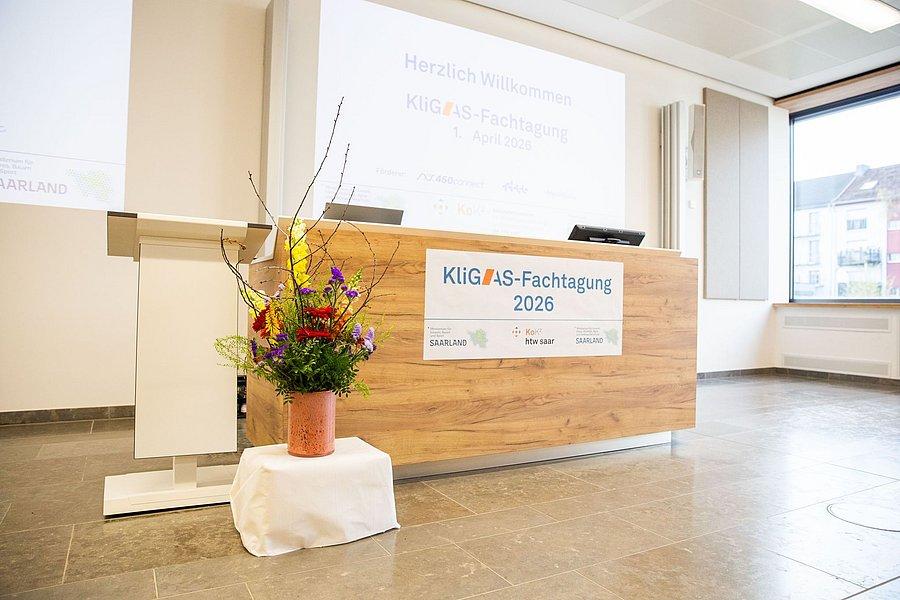
On April 1, 2026, the KliGAS symposium—organized by the Saarland University of Applied Sciences (htw saar) and the Saarland Ministry of Environment, Climate, Mobility, Agriculture, and Consumer Protection of Saarland (MUKMAW). 160 experts from academia, government agencies, disaster management, and the field exchanged views on the Climate Hazard Defense System (KliGAS), which is currently under development at the Center of Excellence for Climate Impact Adaptation and Disaster Management at htw saar (KoK²).
Prof. Dr.-Ing. Dieter Leonhard, President of htw saar, along with State Secretaries Sebastian Thul (MUKMAV) and Torsten Lang from the Ministry of the Interior, Construction, and Sports, opened the symposium. They highlighted the importance of early warning systems against the backdrop of increasing extreme weather events.
“Extreme weather events pose growing challenges for our society in terms of long-term, sustainable preparedness on the one hand, and the ability to act quickly in acute situations on the other. KliGAS, which is being developed for the Saarland at the htw saar’s KoK² Center, will support emergency responders and government agencies and contribute to the protection of citizens, businesses, and infrastructure. By addressing climate impacts, disaster prevention, and disaster management, the center tackles relevant issues of public services and safety,” said Leonhard, himself a water resources engineer. The event’s supraregional significance was also underscored by the participation of institutions such as the Federal Institute of Hydrology and the Luxembourg Water Management Office.
The conference focused on current research findings, practical case studies, and prospects for the statewide rollout of KliGAS. In the morning, expert presentations covered the KliGAS Blies research project, the system’s current state of development, and state funding opportunities for water level monitoring and early warning systems. Speakers from the company 450connect were invited to discuss the system’s security in the event of a potential blackout (power and internet outage). In the afternoon, workshops were held to promote collaboration between the various user groups and the developers. In a comprehensive simulation scenario based on the 2024 Pentecost floods, speaker Joshua Becker (Project Engineer at KoK2) demonstrated the core functionalities of KliGAS. This was followed by two workshops that addressed possibilities for cross-institutional use of KliGAS and the expansion of the user interface. The workshops led to the formation of a working group tasked with developing proposals for a cooperation agreement. It also became clear that KliGAS can already make a valuable contribution to managing flash floods and high water levels at its current stage of development, and that participants prefer a statewide approach in this regard.
“KliGAS links data from various sources in real time and makes it immediately usable by emergency responders. In addition to standard water level forecasts, the focus of this new development is on forecasting flood-prone areas, water depths, and flow velocities. In this way, the system supports informed decision-making and improves the response capabilities of emergency responders during extreme weather conditions,” explained Prof. Dr. Alpaslan Yörük, scientific director of KoK².
The presentations, results, and key findings from the event are summarized in the following publication: Proceedings of the KliGAS Symposium