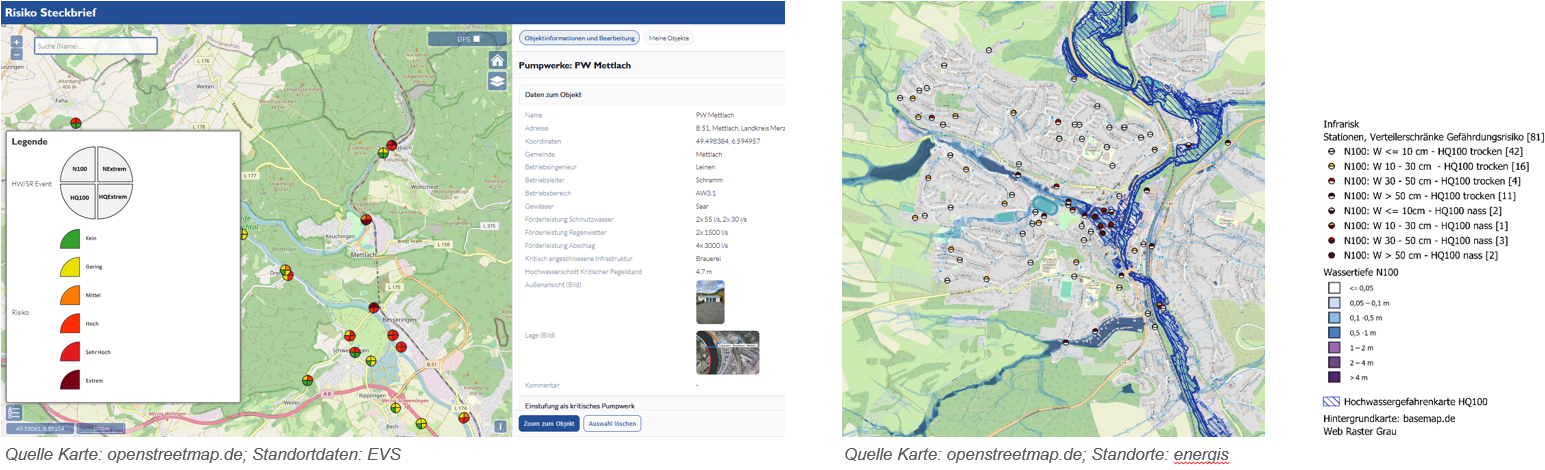

Several projects are addressing flood risks at critical points in the electricity, water, and gas networks operated by energis-Netzgesellschaft, as well as at wastewater treatment plants and pumping stations operated by the Saar Waste Management Association (EVS). During and after the 2024 Pentecost floods, it became clear to many residents of the Saarland just how devastating the consequences of critical infrastructure failures can be. A power outage caused by flooding at grid nodes often has widespread consequences, as it can render pumps—which are essential for flood control, for example—inoperable. Wells affected by flooding can lead to the contamination of entire drinking water systems. The failure of just one pumping station in Blieskastel had disastrous consequences for Blieskastel’s old town on Pentecost 2024. A series of unfortunate circumstances unfolded here: floating debris had damaged one of two bulkheads to such an extent that it could not close. As a result, the pumps shut down due to overload caused by the large volumes of water. This allowed water to flow into the old town through the overloaded sewer system, and the pumping station became inaccessible. The pumping station is now being rapidly modernized and equipped with additional bulkheads.
The basis for the investigations is provided by modeling results obtained using 2D surface runoff models. To this end, the researchers simulate various heavy rainfall scenarios to determine water depths, flow velocities, and flood areas.
In addition to flood risks, the study is also examining options for early warning systems and for integrating these warnings into operational procedures.